
Smartphones have become the center of modern life. People are buying, booking, and making decisions from their palms.
However, many businesses are still using standard software that is not customized to their business. Businesses are typically forced to fit the software into their workflows with off-the-shelf apps, instead of the software fitting the business. This can lead to friction, stifle growth, and disappoint customers who are looking for a seamless digital experience.
This is where custom mobile app development comes into the picture. It provides a means to create software that will fit your business like a glove. There’s no longer a size fits all solution.
This guide covers the concept of custom apps, their importance, who can use them, and how they can impact business outcomes.
What Is Custom Mobile App Development?
Custom mobile application development refers to the creation of a mobile application that is tailored to the specific needs and objectives of your business.
By 2025, global mobile commerce revenue is expected to be nearly $2.5 trillion, representing 63% of total retail e-commerce revenue. This implies that custom apps are designed to address your unique issues, as compared to generic apps which are made for all.
Why Mobile Apps Matter for Modern Businesses
Today, approximately 4.7 billion people are using their own mobile internet devices. That is, over half the earth is equipped with a computer in its pocket. 200 million new users connected online via their phones in 2024 alone, representing the highest growth in three years.
It’s established that mobile apps are necessary. They place your business right in your customers’ hands, making it easier for them to opt for your business rather than your competitor’s. Let’s take a look at a couple of practical ways that companies utilize apps to make that happen:
Online shopping – Viewing catalogs and ordering online without going to a store.
Appointment scheduling – Clients book appointments at their own time, rather than a phone tag and endless email chains.
Food ordering – Restaurants can place orders directly in the app, eliminating the need for third-party platforms and their fees.
Customer support – Users solve problems by chatting in-app, which is quicker than waiting on hold or sending an email.
Businesses – Teams communicate and share updates from anywhere, staying on track with projects.
Eventually, many organizations will seek out mobile app development services to create something that’s truly suitable to the way they work and the way their customers work.
Who Needs Custom Mobile App Development?
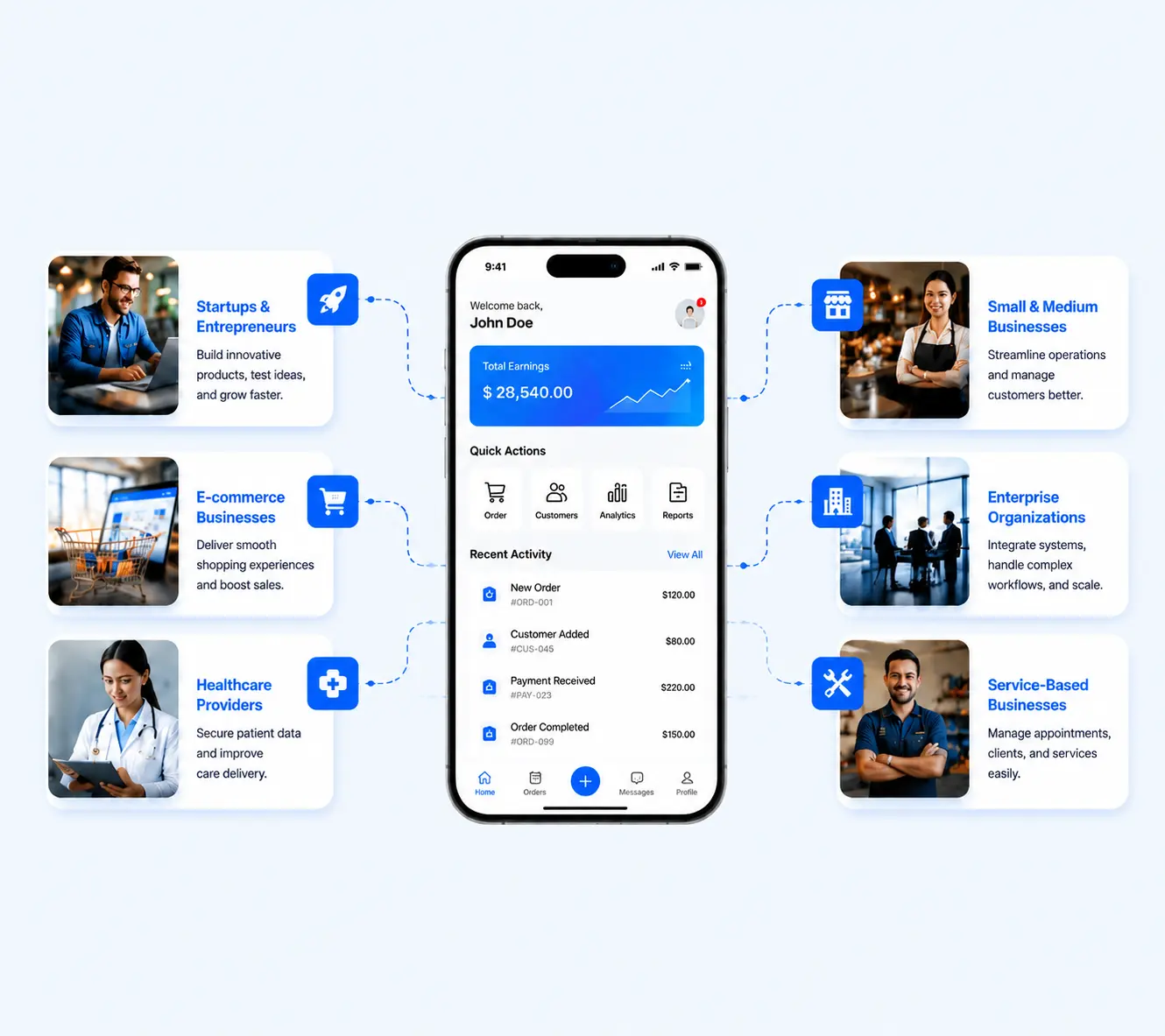
Many people think that custom applications are just for large businesses with a big budget. The answer is not how big your business is, it’s how unique your needs are.
If you have a specific need that can’t be met by ready-made software, or if you are looking for a solution to a specific problem that is not offered, then you’re a good candidate for a custom app.
Keeping all this in mind, here are the players who are the biggest winners of custom business app development:
Startups and Entrepreneurs
If you’re on a new venture, you must get any sort of advantage you will be able to get. You can test your ideas with real users and make changes based on their feedback with a custom app.
Small and Medium-Sized Businesses
When you’re a small business owner, you have to wear many hats. There’s no time to battle with software that doesn’t work exactly as you want.
Enterprise Organizations
Generic apps often cannot handle growing volume or complexity but custom apps integrate with your existing systems and keep everything connected, no matter how large your operation grows.
E-commerce Businesses
If your checkout process feels clunky or your product recommendations seem random, customers will leave without completing their purchase. E-commerce businesses use custom apps to personalize the shopping experience.
Healthcare Providers
Patient information is sensitive and custom apps offer the proper security and controls to safeguard patient data.
Real Estate Companies
Custom apps make house hunting easier by offering advanced search tools, virtual tours, and instant updates when new properties become available.
Educational Institutions
A custom learning app adapts to the school’s curriculum, grading system, and communication style.
Logistics and Delivery Companies
Custom apps are able to be integrated with fleet management systems, offer real-time tracking, and give drivers the routing information necessary to avoid costly delays.
Service-Based Businesses
A custom app enables salons, repair shops, consultants, and others to streamline their scheduling and customer management.
Common Challenges with Generic Mobile Apps
The very features that made generic mobile apps easy to adopt become the things that hold you back. Here are the most common challenges businesses run into:
Limited customization – Generic tools often solve only about 75% of the problem, and that missing 25% costs you money every single day (source). When your business has unique processes, you end up adapting to the software rather than the other way around.
Features that don’t align – These apps are built for the average user, not for your specific industry or customer base. This forces employees to find workarounds, which wastes time and creates frustration.
Integration struggles – Connecting a generic app to your existing systems like accounting software or customer databases is often difficult.
Scalability limits – As your customer base grows and transaction volumes increase, off-the-shelf solutions start to slow down.
Security gaps – The average cost of a mobile app security breach reached $6.99 million in 2025. That is a risk that grows as your business handles more sensitive customer information.
Vendor dependency – You are at the mercy of the vendor’s roadmap. If they decide to remove a feature, change the interface, or increase prices, you have no choice but to accept it.
Custom Mobile Apps vs Off-the-Shelf Applications
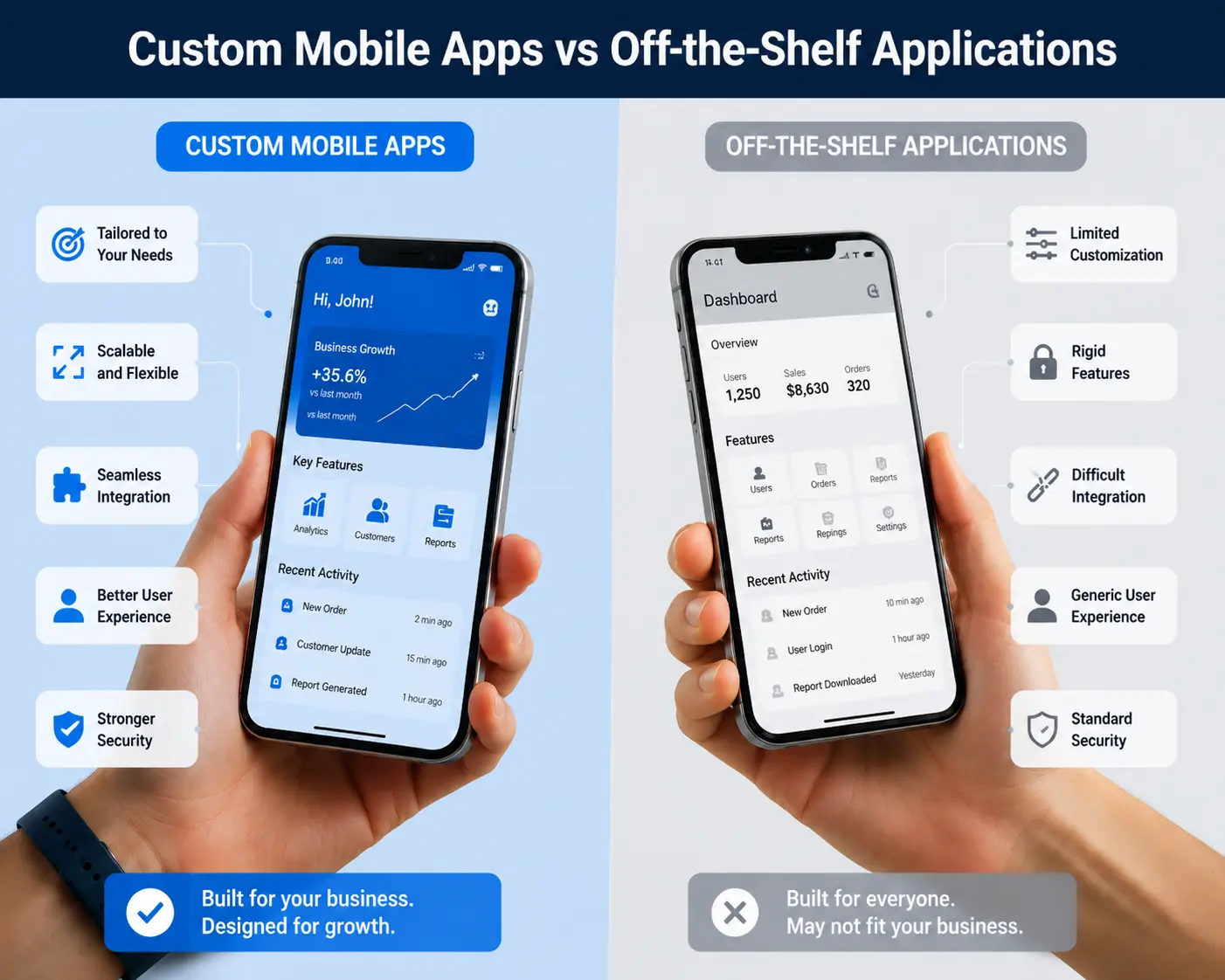
The decision depends on your budget, timeline, operational complexity, and growth plans. You can observe this straightforward comparison of what each approach offers:
Custom Mobile Apps
Built around your business – Every feature is designed to match your specific workflows and customer needs.
Flexible and scalable – The app grows with you. When your business expands, the app expands too. You gain operational independence to make changes when you need them, without waiting on a vendor’s roadmap (source).
Unique functionality – Your competitors cannot copy what you have built.
Seamless integration – The app connects with your existing tools because it was designed to work with them.
Full control – You decide when and how to update features, without waiting on a vendor’s schedule.
Off-the-Shelf Apps
Ready-made – You purchase and deploy immediately. No development time required.
Faster launch – You can start using the app within days, not months.
Lower upfront cost – The initial investment is significantly smaller than building from scratch.
General-purpose features – The app does a little bit of everything, but nothing perfectly aligned to your needs.
Limited customization – You are stuck with what the vendor provides, whether it fits or not.
When to use – You are a startup testing a new market, have simple operations, or are working with a tight budget.
However, if you have unique workflows, require advanced security, or plan to scale significantly, custom solutions offer better long-term value.
Key Benefits of Custom Mobile App Development
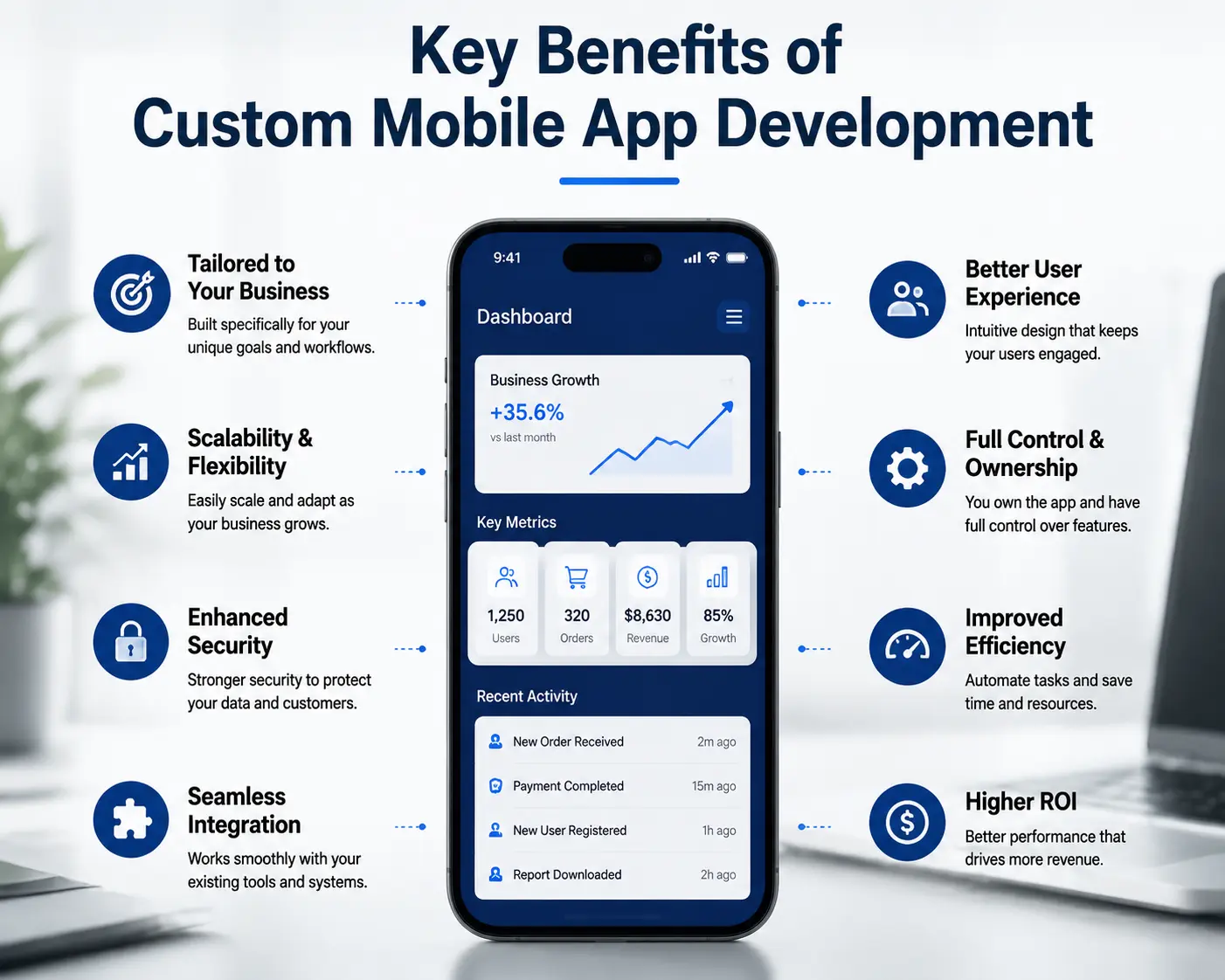
Personalized Features
A custom app matches how you work. Your processes, your rules, your way of doing things are all built into the software.
Better User Experience
Custom apps offer customizable features. This keeps people from getting frustrated and leaving. A well-designed experience means users stick around longer and come back more often.
Improved Security
Custom apps let you build security your way. You control who gets in, how data is protected, and how threats are handled.
Scalability
Custom apps are built to handle growth. The global market for enterprise mobile app development services hit $69.3 billion in 2025 and is expected to reach $120 billion by 2035. That tells you how many businesses are investing in apps that can grow with them.
Seamless Integration
You probably use several tools to run your business: accounting software, customer databases, inventory systems, all of which can be integrated in a custom app.
Competitive Advantage
If your app does something your competitors’ apps cannot, that sets you apart. Maybe it is a faster checkout process or a unique way to book appointments. Whatever it is, custom features give customers a reason to pick you over the others.
How MVP Development Fits into Custom Mobile App Development
Building a full app right away is expensive and risky. You could spend a fortune on features nobody wants. That is why many businesses start with an MVP.
What Is an MVP?
An MVP is a simple version of your app. It has just the basic features needed to solve the main problem for your earliest users. Think of it as a test run that real people can actually use. The goal is to keep it simple and see if your idea works.
Why Businesses Build MVPs
Test out the concept – Do not invest too much if your app does not address a real problem.
Reduce risk – Invest less initially, and see how it works out.
Obtain real feedback – Take in feedback from real users – what works, what does not.
Check for demand – Check whether there is a need for what you are creating.
How the MVP Process Works
Check your idea – Make sure there is a genuine need for what you want to build.
Pick your core features – Decide what is absolutely necessary and what can wait.
Launch a simple version – Get it into the hands of early users.
Listen to feedback – Find out what they like, what they hate, and what they wish was different.
Keep improving – Add new features slowly based on what users actually ask for.
Many startups do this as it provides them with a clear path. They experiment with what works, make changes to what doesn’t, and only create the target app when they know that people want it. Working with an experienced MVP app developer keeps the process focused and on track.
How Custom Mobile Apps Drive Business Growth
When done right, mobile apps help your business grow in practical ways. Here is how.
Better Customer Engagement
An app places your business in your customers’ hands. They can review orders, receive updates, or seek support without calling. This keeps your brand at the front of their mind and helps them trust your business over time.
Process Automation
Manual work is time consuming and prone to errors. Custom apps are used for repetitive tasks such as data entry, sending invoices, and scheduling appointments. Your team ceases busy work and begins work that matters.
Stronger Customer Retention
If customers feel that an app understands them, they come back. A custom app will remember their preferences, recommend items they may want to purchase, and make it easy to purchase again. That turns one-time shoppers into repeat purchasers.
Data-Driven Decisions
Each action within your application provides you valuable information. You observe customers’ browsing habits, purchases, and where they get stuck. These insights will assist you to make the right choices and improve accordingly.
Scalability and Expansion
Your app evolves as you expand to new markets or introduce new products. With custom mobile app development services, you can ensure that your software caters to your aspirations.
Choosing the Right Mobile App Development Partner
The team behind your app makes your app as good as it can be. A good partner is able to turn your idea into a product that works, while a bad partner depletes your money and your patience. When deciding to choose wisely, check for:
Experience and Industry Knowledge
A team that knows your industry understands your challenges. They have encountered similar issues in the past and can see things that you haven’t thought of.
Technical Expertise
The right team has the ability to develop applications that run smoothly and scale effectively. They are up-to-date on new technology and can advise you on the best way for your project.
Portfolio and Previous Work
Look at what they have built before. Find other apps that have similar problems, see the design, user experience, and level of complexity of projects. Their actual performance can be judged from their past work.
Understanding Business Requirements
The best teams take time to learn about your business, your customers, and your challenges. They ask smart questions before they start building.
Communication and Collaboration
Building an app is a team effort. You want a partner who keeps you informed, explains things in plain English, and listens to your input.
Support and Maintenance
Launching the app is just the start. You need updates, bug fixes, and monitoring to keep everything running. When you choose a reliable partner for their software development services, they provide long-term support so your app stays in good shape.
Is Custom Mobile App Development Right for You?
For businesses to compete, mobile apps are no longer an option. With expert custom mobile app development services, you can go beyond out-of-the-box software and create a truly business-specific app. The right app helps you work smarter, serve your customers better, and grow with time, whether you’re a beginner or an established business. The initial cost can be steep, but so can be the long-term benefits.
Frequently Asked Questions
Q: What is custom mobile app development?
Custom mobile application development is an application creation service that is specifically tailored to your business. You’re getting software that’s based on your workflows and the needs of your users. You end up with an app that fits your business, your brand, and your objectives.
Q: How much does custom mobile app development cost?
This will depend on your needs. The simpler the app, the lower the cost. The more functionality it has, the more expensive it becomes. Design, platforms, and integrations are all factors that influence the final price. The best way to get a realistic idea is to have a conversation with your development partner as they will be able to assess what you need.
Q: How long does it take to build a custom mobile app?
The timelines will depend on your project requirements. It could take a few months for a basic app that has the core features, or longer for a full-featured app. Remember that it is a process – planning, design, building, testing, and launching all take time to get right.
Q: What is the difference between custom and off-the-shelf apps?
Custom apps are created for you. They provide you with the features you require, they are compatible with your current tools, and they give you full control. Off-the-shelf apps are ready to use and relatively fast to implement, but you can’t change much beyond basic settings. The final decision will depend on your budget, time horizon, and your unique needs.
Q: Can small businesses benefit from custom mobile apps?
Absolutely. Custom apps can boost automation, customer engagement, and growth for small businesses. For those who prefer not to use generic software, a custom app can be a strong option. It’s not just for large enterprises.
Q: What is MVP app development?
MVP stands for Minimum Viable Product. A simple version of your application, with only the essential features available. You launch it, test with actual people, and make changes as you go. This method will save you money and lessen the risk since you are not constructing everything at once.