
What Is an MVP in App Development? A Complete Guide
There is an observation we have about founders. Let’s take Luke, for example, he has an app idea that he gets completely obsessed with.
He spends sleepless nights sketching features, planning every screen, imagining all the things his product will eventually do. And then reality hits. He realizes he has no idea whether anyone actually wants what he is building.
That’s where MVP plays such an important role. Many startups fail because they try to build a complete product too early. Full product development requires large budgets, long development cycles, and heavy investment. For founders with new ideas, this approach can be extremely risky.
This guide covers everything you need to know about the Minimum Viable Product approach: what it is, why startups build MVPs, real-world examples, how the development process works, and when your business should build one.
What Is an MVP in App Development?
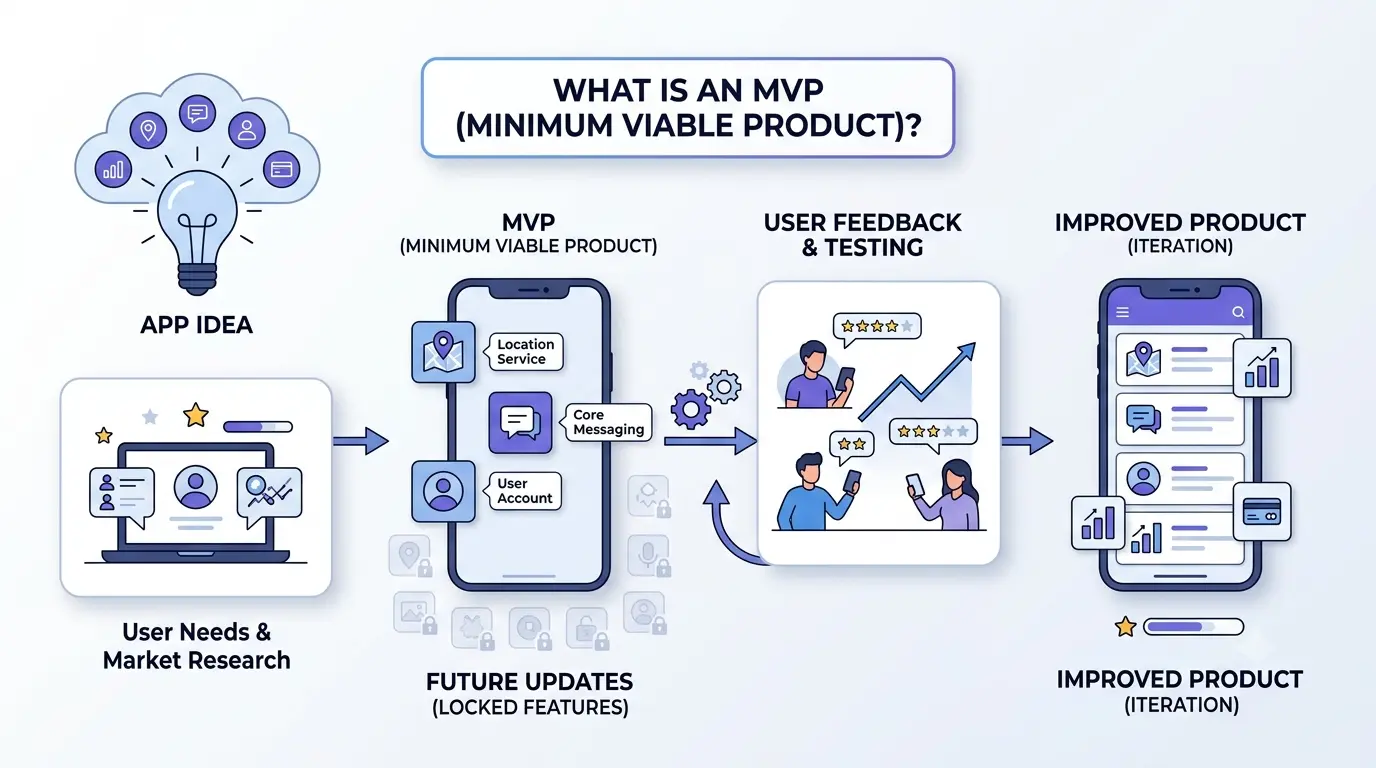
A Minimum Viable Product is the smallest possible but workable version of your app idea. You keep only the features that directly solve a specific problem for your early adopters. Everything else gets cut.
Think about the most basic version of your product that someone would actually find useful enough to download and try. That is your MVP.
An MVP allows companies to:
Test product ideas with real users before heavy investment
Gather honest user feedback that shapes the next version
Validate demand before committing to a full build
The product then improves over time based on what you learn from those early users. This is called iterative development, and it is the core principle behind the MVP approach. If you’re new to mobile app development, understanding the MVP approach early can help you avoid investing in unnecessary features before validating your idea.
What Does MVP Mean in Product Development?
MVP is a product strategy, not just a development method. The concept was popularized by entrepreneur Eric Ries through the Lean Startup methodology. He built the entire framework around one core idea: founders must validate their assumptions before investing heavily.
He calls the alternative the “build it and they will come” fallacy, and it has cost founders billions of dollars in wasted development.
In practical terms, minimum viable product development focuses on three things:
Testing assumptions – finding out quickly whether your core belief about your users is actually true
Learning from real users – not from surveys or focus groups, but from actual behavior inside a working product
Improving through iteration – using what you learn to make the next version meaningfully better
Whether you’re building a startup product or investing in custom mobile app development, validating your concept first helps reduce financial risk significantly.
Why Do Most Startups Fail Before They Even Launch?
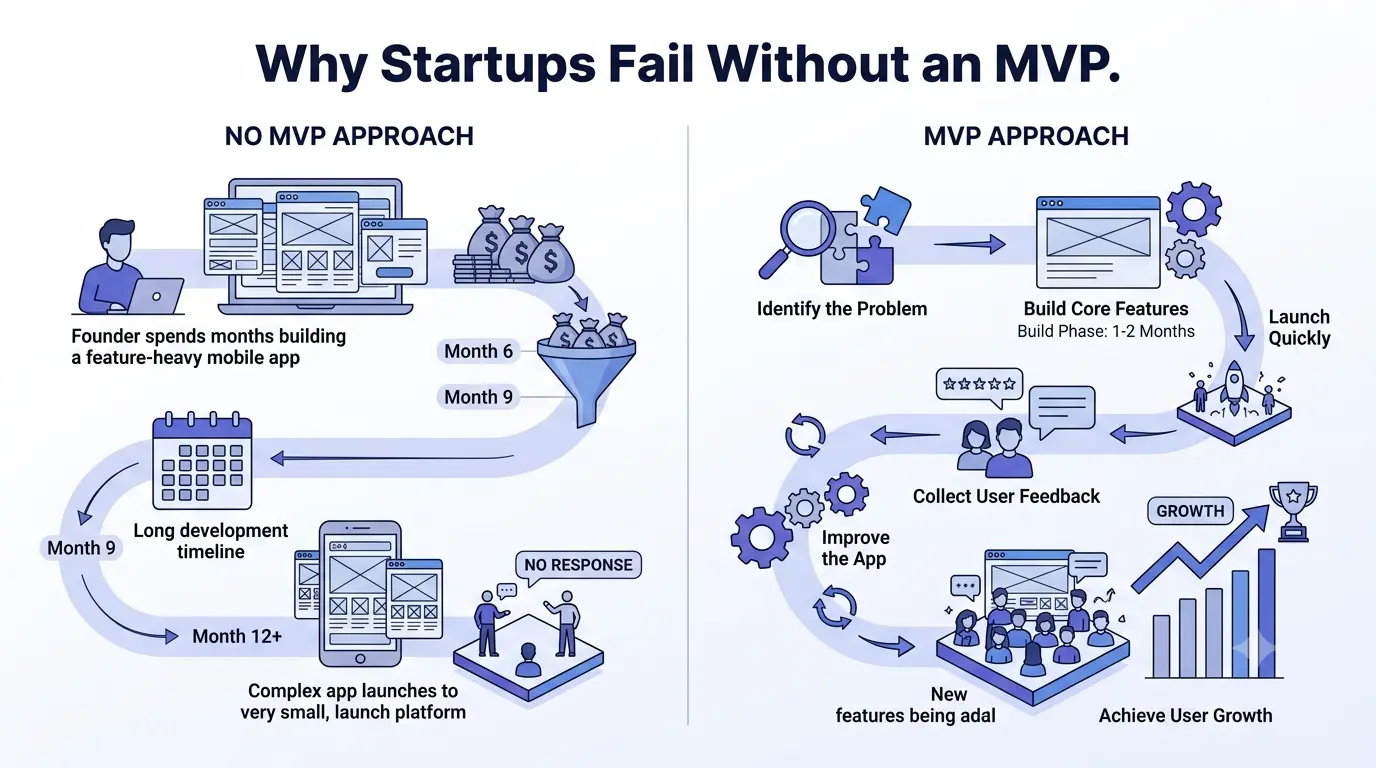
Let us describe a scenario that plays out constantly in the startup world. A founder raises money or drains their savings. They hire developers, spend six months building something polished and impressive. Then they launch to absolute silence. Zero downloads.
That is the Waterfall approach in action:
You map everything out in advance
You write exhaustive specifications
You assume you already understand what customers want
Then you disappear for months and emerge with a finished product
The problem is that assumptions are usually wrong. According to CB Insights, nearly 90% of startups crash and burn. The most common cause? They build products that solve problems nobody actually has. That is painful to hear, but it is also avoidable.
Instead of betting everything on one big release, you start with an MVP for startups. You invest just enough to test your biggest assumption. If users do not show up, you lose less and learn more.
Why MVPs Are Important for Startups
The cost of building software in America is no joke. Top engineers command premium rates. Those costs add up fast when you are building features nobody asked for. That is exactly why understanding the benefits of MVP development matters so much for US entrepreneurs.
Startups operate with limited funding, limited time, and high uncertainty. Building a full product immediately can lead to wasted resources if the idea fails. Here is how an MVP protects you.
You Protect Your Cash Reserves
A full build can drain your bank account before you ever learn whether customers actually care. With an MVP, you invest just enough to test your biggest assumption. Paul Graham from Y Combinator points out that most startups die when they run out of money, but an MVP buys you more time to find what works.
You Beat Competitors to Market
The US landscape moves incredibly fast as new players appear constantly and consumer habits shift weekly. An MVP lets you launch in weeks and observe real users. Foursquare proved this when they launched their basic check-in app at SXSW and grabbed millions of users before bigger companies even entered the space.
You Discover What Users Actually Do, Not What They Say
A full product in development means zero customer data. An MVP gives you access to real insights on your target audience’s behavior. The gap between what users say they want and what they actually do makes all the difference in shaping your product.
You Confirm Your Business Model Before Expanding
The US market varies dramatically across regions. A product that works in California might not resonate in Chicago. An MVP gives you space to experiment with pricing and positioning before committing major resources to a nationwide rollout.
You Approach Investors From a Position of Strength
US venture capitalists have seen too many products that looked great but attracted no users. They want data, not promises. A successful MVP with real user activity gives you exactly that. So ask yourself honestly: are you building features because they excite you, or are you solving a problem that real people have confirmed matters to them?
Who Should Build an MVP?
MVP development is useful whenever there is uncertainty about market demand. That covers more situations than most founders realize. Here are the scenarios where it makes the most sense:
Startup founders launching a new mobile app with an unproven concept
Entrepreneurs testing a new digital business idea before raising investment
Companies entering a new digital market where customer preferences are unknown
Businesses experimenting with a new product feature for an existing customer base
Product managers who need real data before committing engineering resources
The common thread is uncertainty. If you already know your users will pay for something because they are paying for something similar right now, a full build might make sense. If you are making assumptions, an MVP is almost always the smarter starting point.
How Is an MVP Different From a Prototype or a PoC?
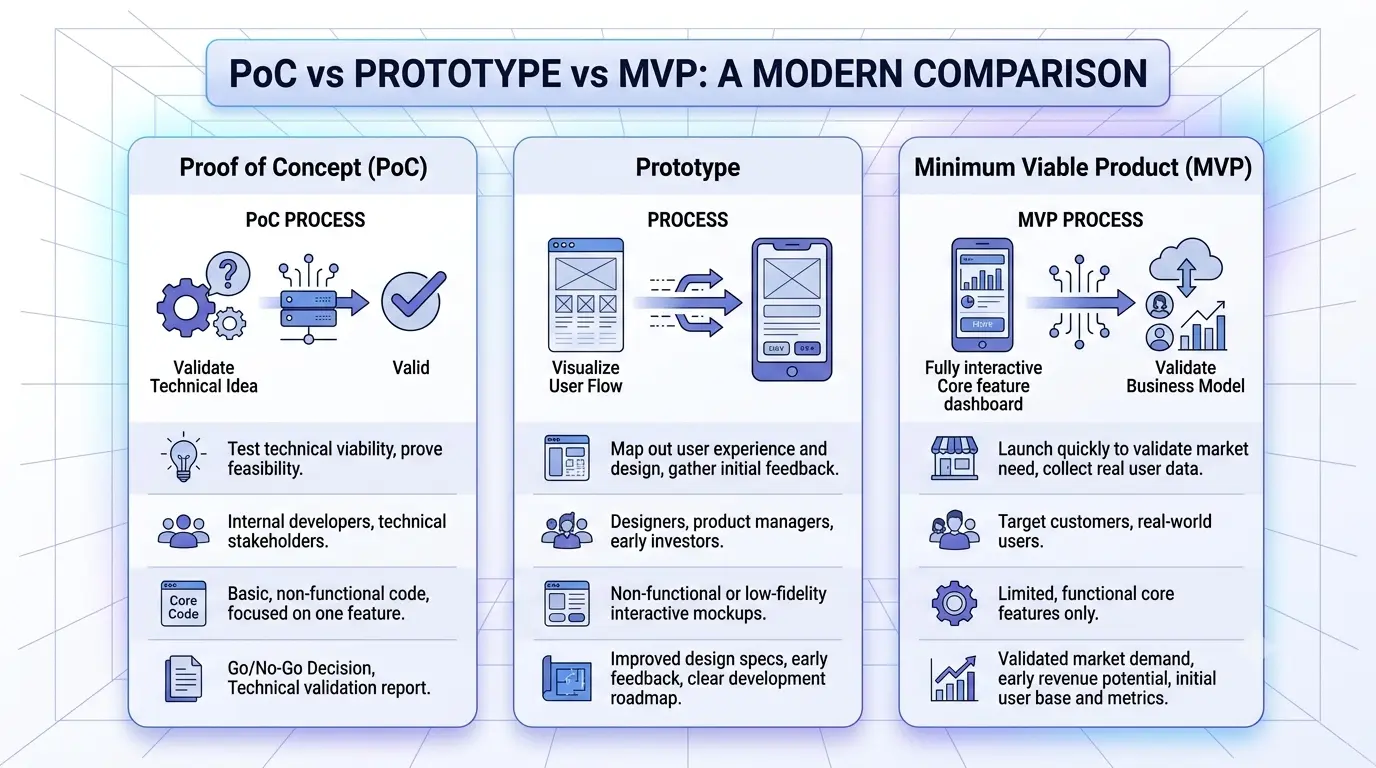
These three words get used interchangeably all the time, and that confusion has cost founders a lot of money. Here is a breakdown that actually sticks.
| Proof of Concept (PoC) | Prototype | MVP | |
|---|---|---|---|
| Purpose | Test if the technology works | Test if the design works | Test if the market works |
| Audience | Internal engineering team | Internal stakeholders and test users | Real paying customers |
| Functionality | Limited technical test | Clickable simulation | Working product with core features |
| Outcome | Feasibility confirmed or rejected | Usability feedback | Revenue and market validation |
If you eventually want external funding, investors do not care about your clickable prototype. They do not get excited about your technical feasibility test. They want evidence that customers are willing to pay.
Think about Zappos. The founder did not build a sophisticated e-commerce engine with real-time inventory syncing and warehouse management. He walked into a local shoe store, took photos, posted them online, and physically went back to buy the shoes whenever someone placed an order. Clunky? Absolutely. Effective? Completely. It proved people would buy shoes over the internet before he invested in serious infrastructure.
Famous Examples of MVP Products

The best way to understand the MVP concept is to see how companies you already know used it. None of these started with the polished product you use today.
Airbnb
The founders rented out air mattresses in their own apartment to conference attendees who could not find hotels. No sophisticated booking platform, no professional listings, no global infrastructure. Just a simple website and a willingness to test whether strangers would pay to sleep in someone else’s home. They proved the concept worked, then built everything else around that proof.
Dropbox
Before writing a single line of cloud storage code, the founder made a simple demo video walking through how the product would work. The waiting list grew from 5,000 to 75,000 signups overnight. That video was the MVP. It validated demand without spending months on development.
Uber
The first version launched in San Francisco only, worked exclusively on iPhones, and required users to send a text message to request a ride. No surge pricing, no driver ratings, no app for Android. Just one city, one phone, one basic function. Once that worked, everything else followed.
Instagram began as an app called Burbn with a location check-in feature, gaming elements, and photo sharing all packed together. When the founders analyzed what users actually did, they discovered almost everyone was only using the photo sharing part. They stripped everything else out and relaunched with a single focus. That stripped-down version became one of the most downloaded apps in history.
Twitter started as an internal side project at a podcast company called Odeo. It launched with just one feature: posting short status updates. No direct messages, no retweets, no trending topics. The team watched how employees used it internally before opening it to the public. Simple and focused was enough to prove the concept.
MVP vs Full Product
Understanding the difference between an MVP and a finished product helps founders set the right expectations before development begins.
| MVP | Full Product |
|---|---|
| Limited core features only | Complete feature set |
| Faster development timeline | Longer development cycle |
| Focused on idea validation | Focused on market expansion |
| Lower development cost | Higher investment required |
| Learns from early user behavior | Built on validated user data |
| Designed to pivot quickly | Designed for scale and stability |
An MVP is the first step in product development, not the final product. Every full product you admire today was built on top of something much simpler.
Key Features of a Successful MVP
Deciding what goes into your MVP is the hardest part of the process. Most founders include too much. Here is what a successful MVP actually needs.
Core functionality – the product must solve one specific problem well enough that a user would choose it over doing nothing
Real user value – someone must be able to complete a meaningful task from start to finish inside the product
Simplicity – fewer features mean faster development, cleaner feedback, and less confusion for early users
Scalability – the technical foundation should be able to support more features without requiring a complete rebuild later
The most practical tool for deciding what belongs in an MVP is the MoSCoW Method. It separates features into four buckets:
Must-Have – the product simply does not function without these. For a ride-sharing app, matching drivers with riders is a Must-Have.
Should-Have – important but the product still delivers value without them. Driver ratings fall here. Users appreciate them, but the app works without them.
Could-Have – pure polish that improves experience without changing core value. In-app chat between riders and drivers fits this category.
Won’t-Have – the most liberating category. You are explicitly saying “not right now.” These ideas are not bad, they just belong in version two.
If your Must-Haves exceed 60% of total development effort, you probably need to reconsider what is truly essential.
How to Develop an MVP: Step-by-Step Process
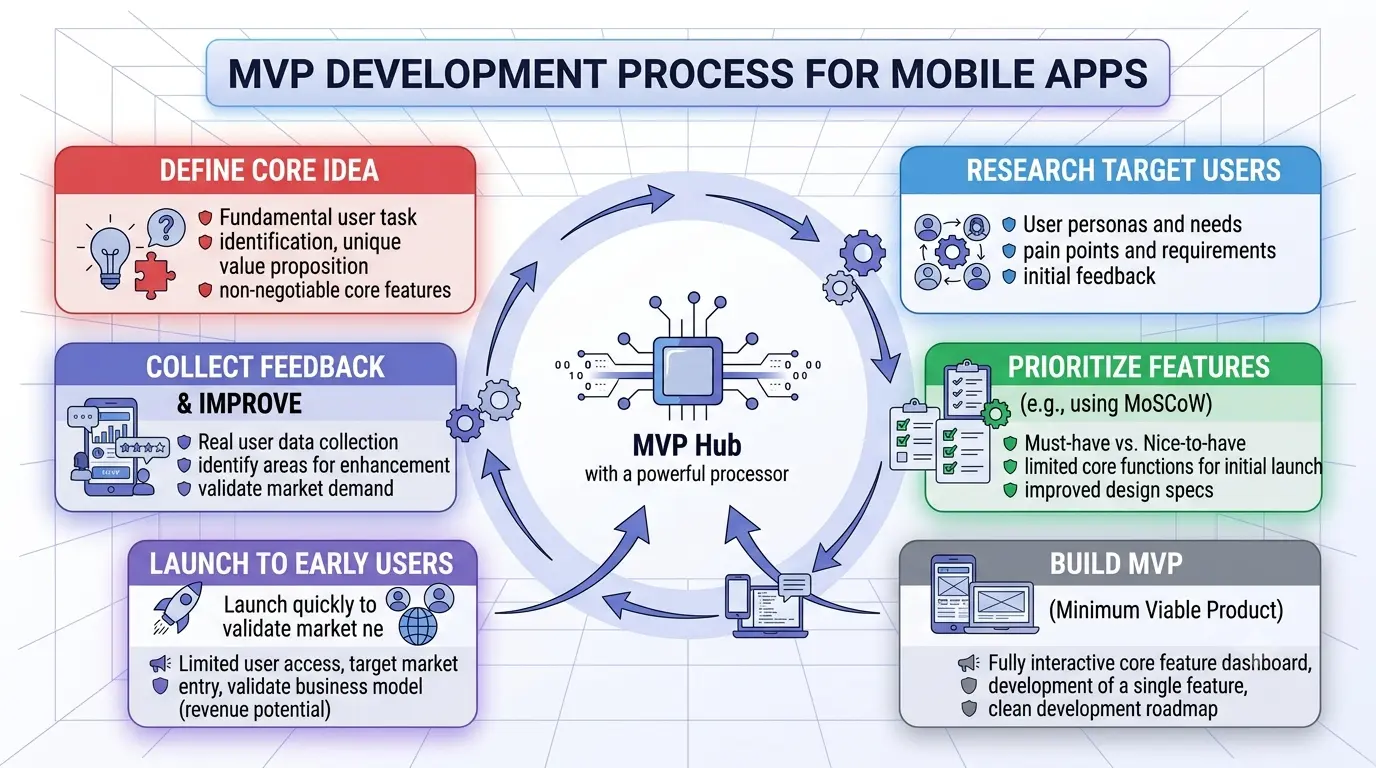
The MVP development process is not complicated once you understand the logic behind each step. Here is a sequence that consistently works.
Step 1: Define Your Core Hypothesis
What is the one thing that absolutely has to be true for your product to work? Write down one sentence: “I believe [these people] have a problem with [this specific thing] and my solution will [solve it this way].” Everything after this sentence should serve that idea. If a feature does not help you test that belief, it does not belong in your MVP.
Step 2: Validate the Market
Before writing a line of code, connect with people who experience the problem you are solving. Ask them about their frustrations, what they have tried before, and whether they would use your solution. If you cannot find anyone who genuinely cares about the problem, that is your answer before you spend a dollar.
Step 3: Map the User Journey
Walk through every single action your users will take from the moment they hear about your product to the moment they get something valuable from it. What do they need to accomplish? What steps do they have to complete? This exercise has a way of cutting through the clutter and exposing features you do not actually need.
Step 4: Prioritize Features Using MoSCoW
Sort every feature idea into Must-Have, Should-Have, Could-Have, and Won’t-Have. Build your MVP from Must-Haves only. This discipline keeps your release lean and actually shippable. This is where most founders trip up by letting Should-Haves creep into the first version.
Step 5: Design the User Experience
Even a minimal product needs a clear and usable interface. Users who cannot figure out how to complete a task will leave and never return. Keep the design simple but intentional. Every screen should serve the core user journey you mapped in Step 3.
Step 6: Build with Core Functionality Only
This is when the actual building happens. Your team creates a working product from those prioritized features. The goal is speed and basic utility, not perfection. This stage follows the same principles used in any structured mobile app development process, where only essential functionality ships before iterative improvements begin. If your MVP targets both iOS and Android, many founders choose cross-platform app development to reduce cost and shorten development time.
Step 7: Launch to a Targeted Test Market
Before you go everywhere, pick one specific place or audience to start. Launching with a focused group of early adopters helps you collect clean feedback without the chaos of a nationwide rollout. Adjust based on what you learn before scaling further.
Step 8: Gather Feedback and Iterate
The launch is just the beginning. Watch what users actually do inside your product. What do they keep coming back to? What do they ignore entirely? What makes them frustrated enough to leave? Their actions tell you what to build next. The MVP development process is a loop: build, measure, learn, repeat.
How Much Does MVP Development Cost?
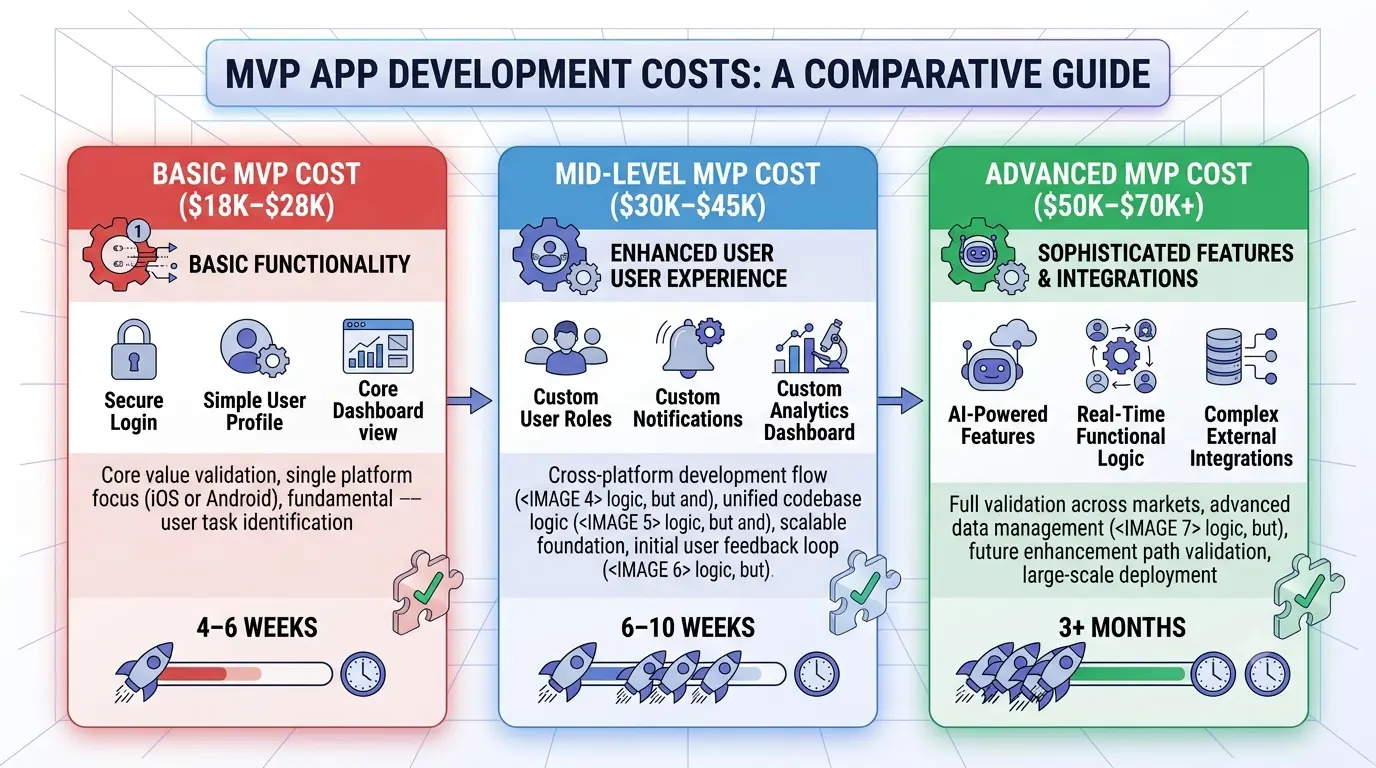
Building an MVP usually lands between $18,000 and $70,000. Here is what actually drives your MVP development cost so you can plan your budget realistically.
Where Your Team Is Based
USA-based developers: $80 to $150 per hour. A full MVP with this setup can quickly top $60,000.
Hybrid approach (US project management + developers in Eastern Europe or Southeast Asia): $25 to $45 per hour. Cuts costs without losing quality.
How Complex Your Product Is
| Complexity Level | Cost Range | Timeline |
|---|---|---|
| Basic MVP (login, dashboard, one or two main functions) | $18,000 – $28,000 | 4 – 6 weeks |
| Mid-level MVP (user roles, notifications, analytics) | $30,000 – $45,000 | 6 – 10 weeks |
| Enhanced MVP (AI, real-time features, complex interactions) | $50,000 – $70,000+ | 3+ months |
The Expenses That Sneak Up on You
Do not forget ongoing costs like cloud hosting, fees for third-party services such as payments or mapping, and regular maintenance after you go live. A simple way to calculate your runway:
Runway = Total Budget ÷ Monthly Burn Rate
| Item | Amount |
|---|---|
| Total Budget | $100,000 |
| Monthly Burn Rate | $20,000 |
| Runway | 5 months |
That means you have 5 months to prove your idea works. Plan your build timeline and test cycles accordingly.
When Should You Build an MVP?
Not every product situation calls for an MVP, but most early-stage ones do. Here are the scenarios where MVP software development is almost always the right call:
Launching a startup with a new product concept that has not been tested with real users
Testing a new mobile app idea before raising a seed round or committing a large budget
Validating market demand in an unfamiliar industry or customer segment
Entering a new digital market where competitor behavior and customer expectations are unclear
Experimenting with a new feature for an existing product before building it into the main codebase
The short version: if you are making assumptions about what your users want, build an MVP first.
Common Mistakes to Avoid When Building an MVP
These MVP mistakes show up constantly. Knowing them in advance is often the difference between a successful launch and an expensive lesson.
Mistake 1: Adding Too Many Features
This is the most common trap. Founders keep adding functionality because they assume more value equals more users. It works in reverse. More features create clutter, delay your launch, and confuse your early users. Start with less and learn faster.
Mistake 2: Skipping Market Validation
Building something without first checking if people actually want it is like cooking a five-course meal for strangers without asking what they like. You need proof that the problem exists and that people will pay for a fix before development begins.
Mistake 3: Confusing an MVP With a Prototype
Sending out a prototype and calling it an MVP teaches you nothing about whether anyone will actually spend money on your product. A prototype shows design. An MVP tests the market. They serve completely different purposes.
Mistake 4: Ignoring Negative Feedback
This one hurts but you cannot avoid it. Negative reactions from early users are the most useful information you can collect. They tell you exactly what to fix and what to cut. Founders who dismiss criticism early almost always pay for it later.
Mistake 5: Waiting Too Long to Launch
The real purpose of an MVP is to learn quickly, not to be perfect. Release it before you feel completely ready. You will learn more in one week of real user feedback than in three months of planning inside your own office.
Mistake 6: Building Poor User Experience
Minimal does not mean messy. If early users cannot figure out how to use your core feature, they will leave without telling you why. Invest enough in UX to make the critical flow intuitive, even if everything else is stripped back.
Is Your MVP Ready to Launch? Check This Scorecard
Go through each item honestly before you go live.
| Your 10-Point Launch Readiness Checklist | Status |
|---|---|
| I can explain the core problem I am solving in one sentence | [ ] |
| I have talked to potential users who confirmed this problem bothers them | [ ] |
| I have sorted features into Must-Have, Should-Have, Could-Have, Won’t-Have | [ ] |
| My MVP only includes Must-Have features, nothing extra | [ ] |
| I have mapped out what users will do from discovery to getting value | [ ] |
| I have built a way to collect user feedback inside the product | [ ] |
| I have defined what success looks like before launch | [ ] |
| I have picked a specific test market or audience to launch to first | [ ] |
| My team is ready to make changes based on user feedback | [ ] |
| I have set aside budget for improvements after launch | [ ] |
Steve Blank, who created the customer development framework, made this point brilliantly: all the answers you need exist outside your office walls. Go find them.
MVP Development Services for Startups
Building an MVP is never just about writing code. Every single day you make tiny choices that either move your product closer to something users need or pull it further away. Experienced teams have already stumbled through those choices on other projects and paid the price for the wrong decisions so you do not have to.
Here is what partnering with MVP development services actually gives you.
Speed Is Everything
Hiring in-house takes weeks or months. Job postings, resume screening, interviews, and onboarding all consume your runway. An experienced MVP development services in USA team is ready in days, not months.
Expertise You Could Not Afford Alone
Agencies give you backend, frontend, UI/UX, and QA specialists working together. You get a full team without long-term commitments, which is ideal for projects that might pivot next month.
Cost Efficiency Works in Your Favor
Outsourcing often costs less than building in-house. No salaries when work slows down, no benefits packages, no office space requirements. You pay for what gets delivered.
Flexibility Lets You Pivot Easily
Startups change direction constantly. With the right MVP app development services partner, you can scale up or down based on what you learn and pause for user tests or restart quickly because the team knows your codebase.
US-Based Partners Offer Specific Advantages
Contracts fall under familiar laws, protecting ownership and confidentiality. Time-zone alignment means fast answers when you hit blockers. Investors also tend to trust products built under US legal and operational structures, which matters when you go to raise your next round.
A solo developer might seem cheaper on paper. But an experienced team will save you from costly mistakes that drain your runway faster than any hourly rate ever could.
So What’s the Final Takeaway for Your App Idea?
Every product you admire today started small. Airbnb with three air mattresses. Dropbox with a simple video. Zappos with photos from a local shoe store. None of them built the final version first, and neither should you.
An MVP gives you a way to test your assumptions before they become expensive mistakes. You do not need to finish the product today. You just need to start learning.
If you’re still refining your concept, exploring profitable app ideas can help you identify opportunities with strong existing market demand. When you are ready to take the next step, custom MVP app development services can help you move faster and avoid the mistakes we have watched founders make over and over. That is how great products actually get built.
Frequently Asked Questions
Q: What is MVP in app development?
An MVP in app development is the simplest working version of your product that solves one core problem for early users. It includes only the features that are absolutely essential, nothing more. The goal is to test whether your idea works in the real world before investing in a full build.
Q: How long does it take to build an MVP?
The timeline depends entirely on what you are building. A straightforward product with login, a dashboard, and one core feature might take four to six weeks. Something with AI, real-time data, or complex user roles could take three months or more. The best approach is to start simple and add complexity only after you validate the basics.
Q: How many features should an MVP have?
Only the Must-Have features that your product genuinely cannot function without. Everything else, the Should-Haves, Could-Haves, and Won’t-Haves, can wait. Launching with fewer features and learning faster is almost always the better path.
Q: Is MVP development only for startups?
No. Many established companies use MVPs all the time, whether they are testing a new internal tool or launching a customer-facing feature that might not work. The validation-first approach works for companies of any size. It is about reducing risk, not about how old the company is.
Q: How do I know if my app idea is worth building?
Talk to real people who experience the problem you are trying to solve. Ask them about their frustrations, what they have already tried, and whether they would use your solution. If you cannot find anyone who genuinely cares about the problem, that is your answer. Save your time and money and find a different idea.
Q: Is MVP development popular in the USA?
Yes. Most US startups now start with an MVP approach. The logic is simple: less financial risk, faster market entry, and real data before you scale. Investors have also come to expect it. They want to see evidence of demand before they write cheques, and a successful MVP gives you exactly that.